Tuesday, 30 January 2018

World’s Largest Investment Company: ‘Interesting’ Bitcoin Is Under ‘Close Review’

World's Largest Investment Company: 'Interesting' Bitcoin Is Under 'Close Review'

NEWS

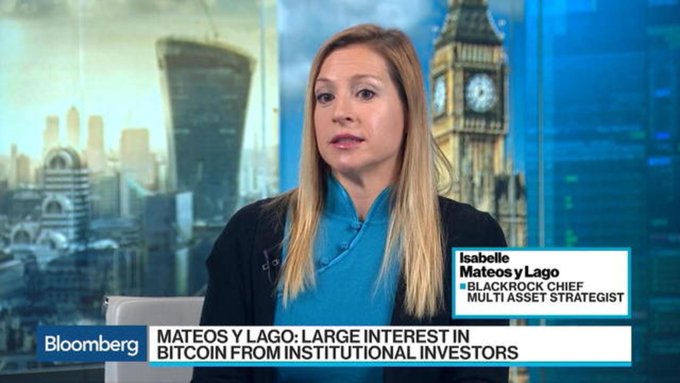
Isabelle Mateos Y Lago, chief multi-asset strategist at BlackRock, an investment management corporation with $5.7 trln in assets under management, has said that the company is keeping cryptocurrency under "close review" as an "interesting development."

Speaking to Bloomberg TV Monday, Jan. 29, the senior executive said that although cryptocurrency did not constitute "an investable asset" for the world's largest money manager at present, it was actively tracking progress as it is "clearly evolving very fast."

The comments temper those of BlackRock CEO Larry Fink, who last week went on record at the World Economic Forum 2018 to describe the space as an "index of money laundering" and previously implied he had no plans to enter the future Bitcoin ETF arena.

As the dust settles on Japanese exchange Coincheck's $530mln hack, Mateos Y Lago nevertheless saw little reason to discard cryptocurrency investment entirely.

"The fact that interest has persisted despite these repeated hacks," she continued, describing customer demand for Bitcoin at BlackRock, "despite regulators waking up and trying to catch up with this new development and gradually weeding out all the illegal uses suggests there really is something to it."

By adopting a 'not-now-but-later' perspective on interaction, BlackRock echoes sentiments from Deutsche Bank's Chief Investment Office leader Markus Mueller, who likewise told Bloombergthat while crypto is for "speculative" investors now, the next five to ten years should see regulatory progress allow its treatment as a "established asset class."

"There's lots of ways to get in; the question is, are they safe?" Mateos Y Lago continued on Blockchain and ICO investment opportunities, saying it was "hard to put a fair value" on them for regular investors.


Follow us on Twitter


19 MIN AGO


--
Please join us at

and start earning money automatically.

Trade DOGE coin, HTML Coin - a promising Cryptocurrency
REGISTER Here for FREE 


Monday, 29 January 2018

Bitcoin Won’t Do a Lehman Collapse: Singapore Central Bank FinTech Chief


Bitcoin Won't Do a Lehman Collapse: Singapore Central Bank FinTech Chief

Advertisement

Get Trading Recommendations and Read Analysis on Hacked.com for just $39 per month.

The financial technology chief of Singapore's central bank does not foresee a scenario where bitcoin would trigger a global financial meltdown akin to the 2008 collapse of investment bank Lehman Brothers.

In an interview with Channel News Asia, Sopnendu Mohanty – chief of financial technology at the Monetary Authority of Singapore, the country's central bank, opined bitcoin will not cause a global financial crisis in the event of a price collapse. The central bank official insisted global regulators are "getting serious about this whole cryptocurrency market", suggesting authorities would step in with regulations when bitcoin markets continue to grow globally.

He stated:

We know exactly when to intervene, based on the market size and the demand and transaction volume, and we will come in at the right time. So, I'm not overly worried about getting to some large financial system crisis.

Specifically, Mohanty pointed to consumer protection regulations to address 'the hype' surrounding cryptocurrency markets.

Singapore, long seen as a technology-forward society, has emerged as a global FinTech hub and has – through its central bank – had plenty to say about cryptocurrencies, blockchain technology and ICOs (initial coin offerings) recently.

After taking a largely hands-off stance on decentralized cryptocurrencies like bitcoin over the years, Singapore's central bank cautioned the general public against cryptocurrency investments in December, at a time when bitcoin price was trading at all-time high near $20,000.

In October, the head of Singapore's central bank insisted that bitcoin itself didn't need any oversight as a cryptocurrency. Instead, MAS chief Ravi Menon insisted a regulator's focus ought to be on the abuse of cryptocurrencies for illicit financing and other illegal activities. "So, those [regulatory] requirements apply to the activity around cryptocurrency, rather than the cryptocurrency itself," Menon said at the time.

Further, the central banker insisted that cryptocurrencies had wider applications in addition to their use as a store of value.

The MAS chief said:

If it [cross-border remittance] was going through a blockchain using cryptocurrencies, it could yield benefits. That ought to be the question, rather than whether bitcoins or ether are going up in value or not.

After issuing a public advisory urging the public to be diligent in investments into initial coin offerings (ICOs) in August, the central bank released official guidelinesfor ICO operators in November.

Featured image from Flickr/sachab.


--
Please join us at

and start earning money automatically.

Trade DOGE coin, HTML Coin - a promising Cryptocurrency
REGISTER Here for FREE 


Cryptocurrency Market Continues Recovery as Ethereum Records 15% Gain

Cryptocurrency Market Continues Recovery as Ethereum Records 15% Gain

Advertisement

Get Trading Recommendations and Read Analysis on Hacked.com for just $39 per month.

The cryptocurrency market has continued to recover at a rapid rate over the past 24 hours, as several major cryptocurrencies such as bitcoin and Ethereum recorded major gains.

Ethereum's Massive Gain

In particular, Ether, the native cryptocurrency of the Ethereum network, demonstrated a staggering 15 percent increase in price overnight, from around $1,100 to $1,235. The recent surge in the price of Ether can be attributed to the progress the Ethereum open-source development community has led in scaling the network.

As shown by Etherscan, the Ethereum network is processing more than a million transactions per day. At its peak, the Ethereum network settled over 1.4 million transactions within 24 hours, demonstrating a daily transaction volume that is seven times larger than that of the Bitcoin network.

The increase in the daily transaction volume of the Ethereum network reflects the exponential growth rate of decentralized applications launched on top of the Ethereum protocol. Applications like EtherDelta, 0x, Radar Relay, and CryptoCribs have gained a significant amount of active users over the past few months.

This week, $1.6 billion cryptocurrency trading platform Coinbase CEO Brian Armstrong praised CryptoCribs, a decentralized Ethereum-based Airbnb-like platform with a non-ICO model. In the cryptocurrency industry, it is difficult to find commercially successful decentralized applications that had not conducted initial coin offerings (ICOs), because ICO has become an easy cash grab for developers.

In July of 2017, Aragon co-founder Luis Cuenda stated that he does not know any Ethereum developer who is not a millionaire yet due to the ICO market.

"I don't know any good Ethereum developer that isn't a millionaire — There's a gold rush among developers to learn the coding language of money," Cuende stated.

As Cuende noted, evidently, there is a gold rush amongst developers, venture capitals, large conglomerates, and large-scale investors to dive into the Ethereum market. The demand for ICOs have increased to a point in which blockchain startups have stopped launching public ICOs. Today, only whitelisted investors and institutional investors can invest in most ICOs.

Additionally, as the scalability of the Ethereum network continues to improve through innovative solutions like Sharding and Plasma, Ethereum will be able to provide a better infrastructure and ecosystem for decentralized applications.

The price and the market valuation of Ethereum solely depend on the performance and adoption of decentralized applications launched on the Ethereum protocol. If decentralized applications continue to perform well, the price of Ether will reflect the success of decentralized applications.

Trend of the Market

While the cryptocurrency market has demonstrated optimistic signs of short-term recovery over the past week, it is still down $240 billion from its monthly peak at $820 billion. At $586 billion, major cryptocurrencies in the global market such as bitcoin, Ethereum, Ripple, Bitcoin Cash, and Cardano will have to record massive gains in the upcoming weeks to bring the market to its previous highs.

But, cryptocurrencies like Ripple and Bitcoin Cash are down by more than 50 percent from their all-time highs and the with the exception of bitcoin and Ethereum, most major cryptocurrenices have not performed well.

Based on a variety of factors such as the entrance of institutional investors through bitcoin futures and the adoption of cryptocurrencies by large-scale financial firms including Robinhood, analysts remain enthusiastic regarding the short-term growth trend of the cryptocurrency market.

Featured image from Shutterstock.


--
Please join us at

and start earning money automatically.

Trade DOGE coin, HTML Coin - a promising Cryptocurrency
REGISTER Here for FREE 


Sunday, 28 January 2018

Crypto-Mining Malware Epidemic: 55% of Businesses Affected Worldwide, Including YouTube

Crypto-Mining Malware Epidemic: 55% of Businesses Affected Worldwide, Including YouTube

24270 Total views
344 Total shares
Crypto-Mining Malware Epidemic: 55% of Businesses Affected Worldwide, Including YouTube

NEWS

Another case of "cryptojacking" was detected on YouTube and resolved by Google over the course of this week, Ars Technica reported Friday, Jan. 26. According to the report, anonymous hackers have managed to run ads on YouTube that consumed the visitors' CPU power and electricity in order to mine cryptocurrencies for the attackers.

The users started posting complaints on social media this week telling that their antivirus programs detected cryptocurrency mining code in the ads that have been displayed to them by Youtube.

According to the report of the cyber security company Trend Micro, the attackers have managed to place mining malware on YouTube via the Google DoubleClick advertising platform. The ads disproportionately  targeted users from Japan, France, Taiwan, Italy, and Spain.

The vast majority - ninety percent - of ads were using JavaScript code provided by Coinhive, a controversial cryptocurrency mining platform that allows its subscribers to earn income by using other people's computing power in an unauthorized manner.

As has been discovered by Trend Micro on Friday, the YouTube ads have been responsible for a threefold increase in Web miner detections worldwide.

In reaction to complaints from the users, Google - who owns YouTube - has announced that the situation has been resolved in a couple of hours. According to an email from the company, "the ads were blocked in less than two hours and the malicious actors were quickly removed from our platforms."

However, there is still no precise information about the timeframe of the events as Google didn't provide any additional data, while Trend Micro claims that the warnings about the abusive ads started emerging as early as Jan.18.

Earlier this month, the software security firm Check Point issued a report about a sharp increase in the prevalence of crypto-mining malware, stating that 55% of businesses worldwide are affected by the attacks. The report declared Coinhive to be the number 1 "Most Wanted Malware."


--
Please join us at

and start earning money automatically.

Trade DOGE coin - a promising Cryptocurrency
REGISTER Here for FREE 

Bitcoin’s Early 2018 Woes Written in the Stars and Moon?


 Bitcoin's Early 2018 Woes Written in the Stars and Moon?

15226 Total views
 
270 Total shares 
By
 
Bitcoin's Early 2018 Woes Written in the Stars and Moon?

ANALYSIS

Bitcoin has prided itself on not being moved by the normal market manipulators, such as global strife and socioeconomic activities. However, there are times when it fluctuates for obscure reasons.

According to some experts, the January downturn could be no surprise as he attributes it to the Lunar New Year and the significance it carries for the Chinese.

The lead up to Chinese New Year is one of high spending as people book all sorts of travel and holidays, not to mention buy presents. Thus, just like Christmas and December is a time for spending in the West, January has a similar pattern in the east.

Blame it on the moon

With Bitcoin's value almost halving from $20,000 in the middle of December to $10,000 at its worst in January, Wallin is both unperturbed or surprised.

"The January drop is a recurring theme in cryptocurrencies as people celebrating the Chinese New Year, aka Lunar New Year, exchange their crypto for fiat currency," explains Alexander Wallin, CEO of trading social network SprinkleBit, as quoted by Bloomberg.

"The timing is about four to six weeks before the lunar year when most people make their travel arrangements and start buying presents," he added.

The holiday takes place on Feb. 16; however, the build-up is where people start to spend their money. And with the Chinese population heavily vested in Bitcoin, it has a huge role to play on the movement of the market.

The thoughts are that people have been taking their profits into the build-up of the New Year, turning their Bitcoin into fiat currency to use for gift buying.

Strange effects

Bitcoin is steadfast in the face of other market influences, the likes that are seen to disturb the traditional stock market, etc. But this theory, if it is to be believed, highlights the way in which Bitcoin moves separately from other assets.

In August, when tensions between Donald Trump and Kim Jong Un were reaching a fever pitch, the entire global market fell by an average of one percent. However, Bitcoin was one of the only assets to report growth during that period.

A pattern emerging

While it may be hard to blame the market decline on something as otherworldly as the moon, there is some evidence to suggest that January is not a good time to be invested in Bitcoin.

Early

There are not too many patterns that have emerged in Bitcoin's price graph over its short lifespan. However, there does seem to be some sort of correlation between this time of year.

What is at least pleasing, if there is a pattern, is that a big rally often follows the January dip.


Follow us on Youtube


--
Please join us at

and start earning money automatically.

Trade DOGE coin - a promising Cryptocurrency
REGISTER Here for FREE 

Tuesday, 16 January 2018

CryptoCurrency Markets Updates : Now it's the time

A more mature crypto market

Even as cries of a bubble get louder, the crypto market has actually trended in the direction of maturation. For one, governments are starting to recognize cryptocurrencies potential and embrace them in some ways. Japan recognized Bitcoin as a legal payment method in 2017 as well as certifying several cryptocurrency exchanges to operate within its borders. Russia announced plans to create its own cryptocurrency, the CryptoRuble, and even Venezuela has revealed plans to launch its own coin.

Others have started to regulate the crypto market, offering hope that increased stability will lead to greater adoption. The EU and several Asian countries have enacted new laws to bring some order to the market. Even in the US, major exchanges have started offering Bitcoin futures as tools for more institutional investment participation.

Dennis Gartman, economist and commodity analyst, The Gartman Letter editor:

"It [cryptocurrency] is gaining some sense of legitimacy by the Cboe.

...When they [cryptocurrencies holders] begin to pay taxes on it, when it ceases to be an avenue for avoiding taxes, when it ceases to be a place where drug dealers are trading and making transactions, then I'll be interested."

More importantly, however, businesses and entrepreneurs have embraced Blockchain, the market's underlying technology, creating a thriving ecosystem of applications and services.

Companies are finding better ways to utilize Blockchain's capabilities, instead of relying on cryptocurrencies' speculative gains. Already, several companies have introduced solutions that improve on several traditional business activities, from creating better agreements—companies such as Jincor, which offers simple smart contract creation—to giving consumers better access to services like financing and cloud storage. Blockchain startups like Cryptopay are facilitating payments with cryptocurrencies, while others like SelfKey are focused on creating better forms of identification for individuals. Moreover, in the financial sphere, businesses like Legolas are improving wealth management and investment platforms.

These applications are quickly gaining popularity, and new companies are finding diverse ways to migrate their services to this architecture. However, many have natural barriers, as Blockchain requires a new round of development and hires.

Currently, most companies still rely on Ethereum's ERC-20 protocol and smart contracts to build new applications, but that paradigm is still dev-heavy. Instead, some companies have already shown better pathways to developing Blockchain-based apps.

This nascent sector has already shown promise, and new applications are further expanding the ecosystem. Qtum, for example, provides a hybrid infrastructure for developers to build Blockchain applications that are suitable for operating with the major Blockchains, while also compatible with mobile and IoT services. The company's dual architecture is based on Bitcoin Core and Ethereum Virtual Machine to allow for the use of smart contracts across platforms. The end-deliverable is a lighter-weight product with cross-chain functionality that outmatches Ethereum's capabilities while broadening Blockchain's appeal. The company has shown significant promise and caught investors' attention, rewarding the valuation with a near 200percent leap higher in December 2017.   

Qtum Charts

Image: Coinmarketcap

Most importantly, however, cryptocurrencies are beginning to find real use cases. Ripple has been successful in carving a niche in banking and business-to-business transactions. Bitcoin Cash promises to solve many of Bitcoin's shortcomings as a payment method, namely scaling and transaction speed. Meanwhile, Ethereum has proven its worth as an infrastructure for application development.

Even with the high volatility in the cryptocurrency market, the overarching trend in 2017 has been overwhelmingly positive. As the industry becomes more widely accepted, it could help significantly stabilize the recent wave of volatility.

2018 could be promising

There are signs that the crypto market is still rather unstable, including sky-high valuations and a rapid pace of growth that has rivaled manias of the past, but 2017 still closed on a strong note.

However, success in the next year will rely heavily on broader adoption. And a market that can withstand speculation waves. Should Bitcoin valuations remain highly volatile, investors and exchanges will eventually be scared off, and trading may decrease. The recent extreme swings experienced by the broader market highlights how precarious the current boom is.

Bitcoin Charts

Chart showing the Bitcoin price movement since 2013

2018 is promising to be a momentous year for the industry. As fears of a bubble collapse increase, many are looking at it optimistically. In their eyes, the ecosystem is ripe for a cleaning, and removing underperformers and unsustainable projects could enable the real contenders to grow. Moreover, a wave of consolidation and the entry of institutional investment into the sphere could lead to broader adoption and a more stable market.

Though the crypto market is growing, it must show sustainability and deliver better fungibility. As more companies demonstrate effective uses for cryptocurrencies and Blockchain technology, the overall ecosystem should continue to stabilize and expand as awareness of its inherent benefits improves.


--
Please join us at

and start earning money automatically.

Monday, 15 January 2018

No CryptoCurrency Ban in Korea

No Cryptocurrency Trading Ban, South Korea Government Confirms

Bitcoin price South Korea Japan
Advertisement
Get Trading Recommendations and Read Analysis on Hacked.com for just $39 per month.

On January 15, in a public press conference, South Korea President Moon Jae-in’s executive office Blue House spokesperson Jeong Ki-joon, emphasized that there will be on cryptocurrency trading ban in the near future.
In an official announcement, spokesperson Jeong noted that the cryptocurrency regulation task force created by the government will improve and alter the original proposal by the Justice Ministry to ban cryptocurrency trading and introduce practical regulations to foster the cryptocurrency market. 
The statement of spokesperson Jeong, translated at CCN, read:
“First, the South Korean government will pursue the crackdown on anonymous cryptocurrency trading accounts and will punish market manipulation, money laundering, and fraudulent transactions through joint investigations participated by the local law enforcement and financial authorities.
Second, the cryptocurrency trading ban proposal introduced by Justice Minister Park Sang-ki was a suggestion made by the Justice Ministry on December 28 to bring speculation within the cryptocurrency market under control. The proposal will be discussed and changed by the task force participated by the Ministry of Strategy and Finance, central bank, Fair Trade Commission, and other agencies.
Third, excessive speculation and fraudulent activities will be met with severe consequences. But, the government will support and even finance blockchain technology development.”
The ban on foreigners and underaged investors from trading cryptocurrencies is expected to be implemented on January 20, and by the end of this month, South Korean cryptocurrency exchanges are also expected to reopen registrations for new users and investors.
The statement of the South Korean government came after several high ranking officials including Nam Kyung-pil, former congressman and a member of the National Assembly, heavily criticized critics and the government for their inability to understand and properly regulate the cryptocurrency market.
“Calling bitcoin a tulip bubble is ridiculing the South Korean people. Its a baseless condemnation of the currency. Gov’t should focus on fostering crypto market if it doesn’t want to be left behind,” Nam said.

Market Optimistic

The South Korean cryptocurrency exchange market along with major trading platforms within it such as Bithumb and Korbit are optimistic about the new approach the government is taking to regulate and foster the local market.
A spokesperson of Bithumb told Yonhap News in an interview that practical regulations are now being imposed, and exchanges in South Korea will be compliant with the new regulations and policies to ensure that the market remains transparent, fair, and stable.
Yonhap further reported that investors within the South Korean cryptocurrency exchange market has become more optimistic and started to feel more safe trading and investing in cryptocurrencies.
In December, Korbit co-president Kim Jin-hwa stated during a government hearing that if the government intends to tax traders and impose strict regulations, it must first provide an even playing field for both cryptocurrency businesses and investors. Kim emphasized that the government should not create a difficult ecosystem for investors by failing to foster the market.
Although a cryptocurrency trading ban is always a possibility, given the unpredictable nature of the South Korean government, as of current, a trading ban seems highly unlikely, because of the massive backlash the government has received from its people.
Featured image from Shutterstock.
Follow us on Telegram.

Advertisement